A Colorblind Constitution
BreakPoint Daily Commentary

Audio By Carbonatix
By John Stonestreet, Crosswalk.com

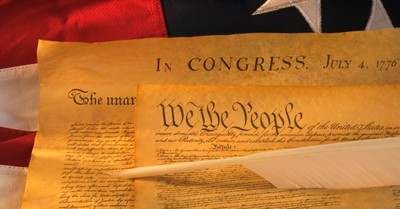
This month marks the 130-year anniversary of one of the most infamous cases in the history of the U.S. Supreme Court. Plessy v. Ferguson (1896) challenged a notorious “Jim Crow” law, one of many that replaced slavery with segregation in the South. The now nearly universally discredited decision from the Court is worthy of reflection, especially in light of the 250th anniversary of the Declaration of Independence.
Homer Plessey was a black man arrested for buying a ticket for a “white” train car. He was arraigned before Judge John Ferguson for defying a Louisiana law that required railroads to provide “equal but separate” cars for people of different races. Plessy argued that the Louisiana law imposed a badge of servitude on him and denied him equal protection under the laws and the exercise of his privileges and immunities as a U.S. citizen. The state of Louisiana argued it was a reasonable exercise of the state’s police powers.
The case worked its way to the U.S. Supreme Court, where, in a 7-1 decision, the Court upheld Louisiana’s law as constitutional. This allowed Louisiana to rely on “the established usages, customs, and traditions of the people.” The decision dealt a crucial blow to efforts for racial equality, validating the “separate but equal” doctrine as constitutional for several decades.
The lone dissent came from Justice John Marshall Harlan, an elder who taught in the Presbyterian church until his death, including during his years on the Supreme Court. He was sincere in his Christian faith, even earning a chapter in Cambridge University Press’s volume, “Great Christian Jurists in American History.” An early supporter of slavery and opponent of Abraham Lincoln, Harlan came to see the end of the Civil War and the subsequent amendments to the Constitution as part of God’s divine plan to free the nation from the evil of slavery.
He referred to the Declaration as “our political Bible,” with its proclamation of equality as proof of America’s moral legitimacy. In Plessy, Harlan provided what is perhaps the most famous dissenting opinion in Supreme Court history: “Our Constitution is color-blind and neither knows nor tolerates classes among citizens.”
In 1954, in Brown v. Board of Education, the Court overturned the Plessy decision, but in an ironic way. That decision was based on questionable psychological research, which showed that segregation—in that case, school segregation—created a feeling of inferiority in black children. In other words, the Court did not argue that segregation was objectively wrong, but only hurtful.
Though the outcome is to be celebrated, it is striking, as political scientist Dr. Ed Erler noted, that Harlan’s dissent in Plessy was ignored by the Supreme Court in Brown v. Board. The exact reason why is unclear, but Erler suspected it was to make possible future racial distinctions for benign purposes, such as Affirmative Action and racial quotas.
Regardless, the Brown v. Board decision was the first time the High Court sidestepped the Constitution and relied on social science research to justify a decision. As such, it is an example of science replacing a “self-evident” truth—in this case, equality. Had the Court relied on Harlan’s dissent, it would have aligned with the Fourteenth Amendment’s guarantee of equal protection and, in a much larger respect, with the principle of equality found in the Declaration of Independence.
As we consider the legacy of Plessey today, it is fitting to consider one of the greatest contemporary speeches by a sitting Supreme Court justice. Recently, Justice Clarence Thomas spoke at the University of Texas to celebrate the 250th anniversary of the Declaration. Equality, he said, is from God, and “the Declaration is, in fact, along with the Gospels, one of the greatest anti-slavery documents in the history of Western Civilization.” He also spoke of Plessy v. Ferguson, calling racial segregation “grossly incompatible with our colorblind constitution,” and how Justice Harlan’s dissent demonstrated the “right thing to do.”
Whenever the permanently true principles of the Declaration have been rejected, there are consequences. Ideas such as Historicism or neo-Darwinian science cannot replace what is true as a foundation for a good and just society. Thus, Thomas said, we must demonstrate courageous devotion to the enduring principles of the Declaration, if the laws of nature and nature’s God are to guide us, and if we are to make it for another 250 years.
Photo Credit: ©Getty Images/Tetra Images
John Stonestreet is President of the Colson Center for Christian Worldview, and radio host of BreakPoint, a daily national radio program providing thought-provoking commentaries on current events and life issues from a biblical worldview. John holds degrees from Trinity Evangelical Divinity School (IL) and Bryan College (TN), and is the co-author of Making Sense of Your World: A Biblical Worldview.
The views expressed in this commentary do not necessarily reflect those of CrosswalkHeadlines.
BreakPoint is a program of the Colson Center for Christian Worldview. BreakPoint commentaries offer incisive content people can't find anywhere else; content that cuts through the fog of relativism and the news cycle with truth and compassion. Founded by Chuck Colson (1931 – 2012) in 1991 as a daily radio broadcast, BreakPoint provides a Christian perspective on today's news and trends. Today, you can get it in written and a variety of audio formats: on the web, the radio, or your favorite podcast app on the go.


