Mark 2:1-23
Ministries > Thru the Bible with Dr. J. Vernon McGee
https://www.oneplace.com/ministries/thru-the-bible-with-j-vernon-mcgee/
Facebook Twitter Instagram YouTubeJesus saw the paralytic’s faith, forgave his sin, then healed his disability. Why did Jesus do it in that order? Perhaps He wanted us to know how to find true healing from life’s hurts, which can be found only through faith in Jesus and acceptance of His unconditional forgiveness. Are you hurting today? Have faith. He sees you and wants you to find healing in Him.
References
Steve Schwartz: If you wanted to bring a friend to Jesus, and a large crowd of people was blocking the way, what would you do? Welcome to Through the Bible with our teacher Dr. J. Vernon McGee, and he's going to take us to Mark chapter two, where we see four people who literally tore up the roof to get a sick man to Jesus. What amazing friends. I'm Steve Schwartz, your host on this five-year journey through God's whole word, and I'm so glad that you've jumped aboard the Bible bus for this great study. It's an important one. We got a lot of truth to learn about our Lord, and a lot of lessons to apply to our hearts. So, let's get right to it and pray. Heavenly Father, thank you for the opportunity that we have to study your word. May we be stretcher bearers for those who are in need of meeting our Savior Jesus. Give us the courage to go to great lengths, even open rooftops to bring them to you. We pray this in Jesus name. Amen. We're off to Mark chapter two on Through the Bible with Dr. J. Vernon McGee.
Dr. J. Vernon McGee: Now today, friends, we come to the second chapter of the Gospel of Mark. And as we come to this chapter, while we find it's really a continuation of chapter one. In fact, Mark has that marvelous connective and and and it occurs. I forget how many times I told you. I never counted them myself. I took somebody else's word for it, but it certainly occurs many times. And it is a little word that is the cement that holds it together. And it always joins up with what's gone before with what follows it. Now I'm begin reading in chapter two, verse one of Mark. And again, he entered into Capernaum after some days, and it was noise that he was in the house. And I emphasize that word the house. We'll see why in a moment, for there two things in this verse I'd like to emphasize. We find that he entered into Capernaum after some days. We said, I think last time that he moved his headquarters from his hometown of Nazareth down to Capernaum. And the best that I can tell that Capernaum remained the headquarters for our Lord's earthly ministry of three years. Now he had to withdraw, and last time we saw the reason of his withdrawal was due to the fact that this leper which he healed was one who didn't do what he requested him to do. He told him not to tell anyone, and he went out and told everyone. And the crowds pushed in upon him, and our Lord couldn't do his work. Now this is one of several reasons of why the Lord Jesus did not come as a a wonder worker, and he didn't want that to be the thing that would characterize him. And he didn't want this man and others to tell about that because he came from spiritual ministry. He came to die upon the cross for the sins of the world. And this type of thing obscures the Gospel. Now very candidly, and I want to be fair and frank, one of the reasons that I object so vociferously to today these people who put the emphasis on healing or tongues or something like that is even if these were gifts for this age in which we are living right now and at this particular time, then that's getting the cart before the horse. Someone said to me sometime ago, well, Dr. McGee, so and so preaches the Gospel just like you do, and therefore they just do this other thing. Yes, but are they known for preaching the Gospel? Is that the reason people go to the meetings? Is it to hear the Gospel and be saved, or is it to go with an emphasis upon healing or to have some emotional experience? I think that we need today to whittle this down to a very fine point. Our business is primarily to preach the Gospel. And we're going to see that occur again in this particular chapter here. So that the Lord Jesus was hindered because of this, and he left Capernaum for a while. I don't know how long, and then he came back. And when he came back, it says that he came and it was noise. He was in the house. Now the little Greek word the, the article, it's really an adjective in the Greek, and it is so declined. And it always is a modifier, and it would refer to a very particular definite house. Now the question is, what house is mentioned here in these first few verses of the Gospel of Mark? Well, we're told that after he had been to the synagogue that morning, back in chapter one, we're told in verse 29 of chapter one that they entered into the house of Simon and Andrew. And you need to keep that in mind that when these fellows start taking off a roof, they're taking a roof of Simon Peter's house off. And I'm not sure that that man would be docile and stand aside, let him do it. Now I'm not sure he'd have permitted it quite like that. Now we're told that he's in the house. He's returned to Capernaum, and the crowds were there. And notice this straightway, many were gathered together in so much that there was no room to receive them. No, not so much as about the door, and he preached the word under them. And I would emphasize here that he preached the word under them. That was the ministry of our Lord was to preach the word of God. And that is the emphasis that we feel should be made today. It's an emphasis upon the word of God, upon the integrity and in errancy of the word of God. And my prayer for myself in this connection is, oh God, give me more confidence in the word of God. I see what it's doing today in hearts and lives. I know what it's done for me. And as a result, I ought to have even more confidence than I have. And I'll be very frank with you when I make this statement. I wonder whether it's going to have any influence in any heart or life. Well, we trust that it will. But I must confess that I don't have the faith I should have. This is the word of God, and it'll never return under him void. And I rejoice to read here that our Lord preached the word under them. Now we are diverted, and our attention is directed to another group. And it's a little delegation of five. They're coming down the dusty road into Capernaum. And verse three reads, and they come under him bringing one sick of the palsy which was born of four. And when they could not come nigh under him for the press, they uncovered the roof where he was. And when they had broken it up, they let down the bed wherein the sick of the palsy they lay. Now our attention is directed to this little group of five. And they arrange like this. One man with a palsy, poor fellow couldn't even have made it there. He's in that stretcher. And the other four, the quartets at each corner of the stretcher. And here they come. And they can't get in because the crowd is there. They fill the doors and the windows. Now I found out in church work today that the thing that is done more than anything else is done by committees. My experience has been as pastor of many churches that the committee is the one we depend on. Church work is done today largely by committee and different organizations. And a committee, someone has said, is made up of those who take down minutes and waste hours. They are individuals that come together. They individually can do nothing, but together they can decide that nothing can be done. And that's generally what they do. And I think that this little group had a committee. They had a door committee. They came up, looked around, came back, said you can't get in the door. They had a window committee, and they went up and looked around, came back, said you couldn't get in the window. And fortunately, they had a a roof committee. And the roof committee came back, and they said we think we can get him down through the roof. So you see that if you have enough committees, you'll probably get one that will function. And so they decide to let him down through the roof. And these men engaged themselves in that. Now it was a thatched roof made of straw. All they did was lay it back, but the problem was getting that man up to the top, then letting him down in the presence of the Lord Jesus. And when they did that, why they had given all their time and attention to it, I think they were a little embarrassed. And we read then in verse five when Jesus saw their faith. Whose faith? Well, the faith of these men. He said under the sick of the palsy, son, thy sins be forgiven thee. Now that disturbed me for quite a few years. When I looked at that verse, it looked to me like it was the faith of these men that was responsible for this man being saved, for his sins being forgiven. But on closer examination, you see that it wasn't that because I believe when I was troubled by this, and I still believe it that you are saved by your own personal, individual faith. It's wonderful to have a godly mother, but you're not going to heaven tied to your mama's apron strings. And it's wonderful to have a godly father. But your godly father won't save anyone but the godly father. It won't save you. You'll have to exert faith yourself. You have to be the one. And I believe that's true today. Now it's not the faith of these men that saved this man, but it's the faith of these men that brought him where he could hear the Lord Jesus deal with him individually and personally. Because when Jesus saw their faith, it's their faith that brought him there. And then he deals personally with the man, son, thy sins be forgiven thee. Now when you have that situation, it's a little different, you see. And it was the faith of these men that brought him. And what we need today, I think in the church is stretcher bearers, men and women to go out and bring in the unsaved where they can hear the Gospel. Because there are many people today paralyzed. They have a palsy. It's a palsy sometime of sin, a palsy of indifference, a palsy of prejudice. Great many people are not going to come into your church where the Gospel is preached unless you get at the corner of a stretcher and bring them in there. That's what these men did. And so they brought this poor fellow in, and he never would have been in there where he could hear the Lord Jesus deal with him personally and say, son, thy sins be forgiven thee. Now will you notice here that when he does this, our Lord forgives this man. And I read verse six now. There were certain of the scribes sitting there and reasoning in their hearts. And they are the enemy. Now they didn't speak out, but they just thought this. And this was what they thought. Why does this man thus speak blasphemous? Who can forgive sins but God only? Now they are wrong in the first question, right in the second. This man was not speaking blasphemous. They said, who can forgive sins but God only? And they're right in that. Only God can forgive sin, you see. No judge has any right to let a criminal off. His business is to enforce the law. God's the moral ruler of this universe. And he must defend his own laws. He can't be lawless. That's just one thing even God can't be. Having made the laws, why he obeys those laws. And his laws are inexorable. They're not changed at all. But you and I are guilty before God. We need forgiveness of sins, and he forgives not just because he's big-hearted. He forgives us because Christ paid the penalty for our sins. And therefore the Lord Jesus was not speaking blasphemy because he was God, and he come to the earth to provide a salvation even for this man here. Now these men didn't speak out, you see, but they thought this in their hearts. Verse eight, and immediately when Jesus perceived in his spirit that they so reasoned within themselves, he said under them, why reason ye these things in your hearts? Now you see he tries to draw them out. But these men, they've had a run-in with him before, and they always came away with a bloody nose. And they decided the best thing to do here was to keep quiet, and they did. Our Lord says to them, why you reasoning this way in your heart? Whether is it easier to say to the sick of the palsy, thy sins be forgiven thee, or to say, arise, take up thy bed and walk? And by the way, they're not about to answer that at all. They're quiet. And since they are quiet, why he's still going to deal with them, you see. He knew what they were thinking. In the Gospel of John, John 2:25 it says he needed not that any should testify of man. He knew what was in man. And the questions they raised now the Lord Jesus, he puts them on a spot. And he says, which is easier to forgive this man or to say to him, arise and walk? And though they didn't answer, I am sure they would had to have answered and said, well, for us it's just as easy to do one as the other. Or to put it a little differently, it's impossible for anybody but God to do either one. And that was right. And that's the reason the Lord Jesus said, I'm going to say to this man, arise, take up thy bed and walk. But that ye may know that the Son of man hath power on earth to forgive sins, he saith to the sick of the palsy, I say under thee, arise, take up thy bed and go thy way into thine house. And the old Scotch commentators said the reason he told him to take up his bed and walk was he'd not have a relapse. He wouldn't be back on that bed. He wouldn't be coming back to the stretcher. He is going to walk from here on. When our Lord healed, he did a good job. Now we are told, and immediately he arose, took up the bed, and went forth before them all in so much that they were all amazed and glorified God saying we never saw it on this fashion. Now you see this is a Gospel of action, and this is one of the miracles of action. Now we still have action, although there's not a miracle here, but there's a lot of action in the Gospel. Verse 13, and he went forth again by the seaside. And all the multitude resorted under him, and he talked them. And as he passed by, he saw Levi, the son of Alphaeus, sitting at the receipt of custom, and said under him, follow me. And he rose and followed him. Now this is the call of Levi or Matthew. And Matthew, by the way, belonged, of course, to the tribe of Levi. And imagine that, the priestly tribe. And here he has become a publican of all things. And by the way, this ought to answer the question about the 10 lost tribes. This is one of the many places where you find individuals that belong to the other tribes except Judah. When anyone tries to say that we've got 10 lost tribes today, they might be lost as far as those folk are concerned. But this is no Easter egg hunt. They've been found. Here's one of them right here, the tribe of Levi. And he's one of the disciples of our Lord. And our Lord calls him here. This is a remarkable incident. Now you remember Matthew told us nothing about the fact that he gave a great dinner and invited some of his friends. And the only kind of friends he had were sinners, by the way. Now we are told here, verse 15, when it came to pass that Jesus sat at meat in his house. That is the publicans. And that's Levi or Matthew. Many publicans and sinners sat also together with Jesus and his disciples, for there were many. And they followed him. Now when the scribes and Pharisees saw him eat with publicans and sinners, they said under his disciples, how is it that he eateth and drinketh with publicans and sinners? Did you notice three times here we have the statement that the guests that were there were publicans and sinners? Not a good man on the list here, apparently. They were not the elite of the town, publicans and sinners. And if you notice that publicans come ahead of sinners, those were the tax gatherers in that day. Now when the Lord Jesus heard that, when Jesus heard it, he saith under them, they that are whole have no need of the physician, but they that are sick. I came not to call the righteous, but sinners to repentance. That is a tremendous answer. You don't invite the doctor over to your house for dinner and then have him send you a big bill when everybody's well. It's when you're sick that you want the doctor to come over. And the Lord Jesus said that I haven't come to call the righteous. I've come to call sinners. And the reason he said that, actually there was only one kind of folk in that day, and they were sinners. There were no such thing as the righteous by any means. But the Pharisees thought they were. Now verse 18, and the disciples of John and the Pharisees used to fast. And they come and say under him, why do the disciples of John and of the Pharisees fast, but thy disciples fast not? You see, they were under the law. But under the law, there was no instruction given for fasting. God gave seven feasts for his people, not fast days. And Jesus said under them, can the children of the bride chamber fast while the bridegroom is with them? As long as they have the bridegroom with them, they cannot fast. But the days will come when the bridegroom shall be taken away from them, and then shall they fast in those days. Now that is the thing he's saying to them is that it's more important to be related to him and to have fellowship with him than to fast. That's one thing today, friends, to be religious and put up a front. It's another thing to enjoy fellowship with the Lord Jesus and love him. Now he illustrates this. No man also soweth a piece of new cloth on an old garment. Else the new piece that filled it it up taketh away the old, and the rent's made worse. Now that's one illustration. Here's another that's similar. No man putteth new wine into old bottles, that is old wine skins. Else the new wine, it would burst the old wine skins. And the wine is spilled, and the bottles will be marred. But new wine must be put into new bottles. Now the thing that he's saying, friends, is simply this. He said now I have not come to polish up the law. I have not come to add to the Mosaic system. I have not come to add a refinement or development to it. He says, I have come to do something new. I didn't come to patch up the old garment. I've come to give you a new garment. Now under the law, men work. And their works were like a an old moth-eaten garment. But our Lord came to provide a new robe of righteousness that comes down on a sinner that will trust Christ, that will enable him to stand before Almighty God. That is the glorious, wonderful thing, friends, that he's saying here. Our Lord didn't come to extend or project the law or the Old Testament system or religion. He came to introduce something new. And that which is new will be the fact that he'll die for the sins of the world. And that's going to be the new garment. But now he'd like to put a new man in that garment. And therefore new wine goes in new wine skins, and a new garment goes on a new man. And on that robe of righteousness comes down on one who has now become a son of God through faith. This is a tremendous thing. Now we come in the last part of this chapter to the Sabbath day in the fields. Then in chapter three at the beginning, you'll see the Sabbath day inside the synagogue. Now we have seen this before. In fact, these two incidents are in Matthew as we saw them there. And we'll see they're in Luke again. A very important incident because it was here with this question of the Sabbath day that he broke with the religious rulers. From this time on, they sought his death. And he claims in this first one here that he's the Lord of the Sabbath day. And on the inside, he does good on the Sabbath day. Question of course arises, did he really break the Sabbath in either incident when they took the grain and ate on the Sabbath? Did he break the law? When he healed this man with the withered hand, did he break the Sabbath law? And of course he did not. Absolutely did not. He came to really fulfill the law. But here you will find that he's actually giving an interpretation of this and reveals that he is the Lord of the Sabbath day. And doing good was the thing that was all important. So until next time, may God richly bless you, my beloved.
Steve Schwartz: Well, just as these men brought their friends to Jesus, Paul tells us that as believers, we're to do good, especially to those who are of the household of faith. You know, we have an unprecedented opportunity today to do good for literally millions of people, believers and unbelievers alike, as we bring them the whole word of God. Is God leading you to partner with us as we share his word in more than 250 languages? Well, you know, we'd love to have your partnership with us, and we invite you to invest in the blessing of being used by God to share his word. If you want to learn how you can partner with us financially in taking the whole word to the whole world, just click give in our app or over at ttb.org. You can always call 1-800-65 Bible two, or write to us, won't you? At box 7100, Pasadena, California 91109. Our Canadian friends, you can write to box 25325, London, Ontario N6C 6B1. Or to partner with us in this important ministry of prayer, just sign up for our world prayer team over at ttb.org. Is anger a sin? What about when Jesus got angry? Did he sin? Well, we'll find out next time as we gather together for another great study with our teacher Dr. J. Vernon McGee. To get the most out of our time together, why don't you read ahead in Mark chapter three and get a bookmark of our reading schedule so that you can prepare for each study. It fits in your Bible perfectly. Check out our app. Just visit ttb.org or call 1-800-65 Bible. I'm Steve Schwartz, and I'll be here holding the doors of the Bible bus open as you hop aboard next time.
Guest (Male): We're grateful for the faithful and generous support of Through the Bible's partners whom God uses to take the whole word to the whole world.
Related Episodes
About Thru the Bible
Thru the Bible takes the listener through the entire Bible in just five years, threading back and forth between the Old and New Testaments. You can begin the study at any time. When we have concluded Revelation, we will start over again in Genesis, so if you are with us for five years you will not miss any part of the Bible.
Other Thru the Bible Programs:
Thru the Bible - Minute with McGee
Thru the Bible - Questions & Answers
Thru the Bible - Sunday Sermon
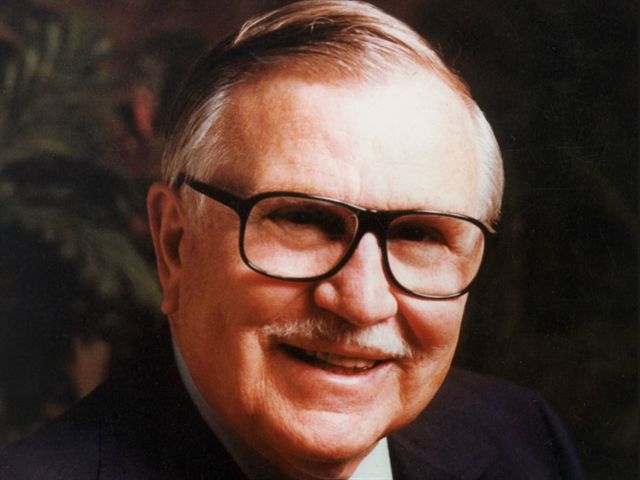
About Dr. J. Vernon McGee
John Vernon McGeewas born in Hillsboro, Texas, in 1904. Dr. McGee remarked, "When I was born and the doctor gave me the customary whack, my mother said that I let out a yell that could be heard on all four borders of Texas!" His Creator well knew that he would need a powerful voice to deliver a powerful message.
After completing his education (including a Th.M. and Th.D. from Dallas Theological Seminary), he and his wife came west, settling in Pasadena, California. Dr. McGee's greatest pastorate was at the historic Church of the Open Door in downtown Los Angeles, where he served from 1949 to 1970.
He began teaching Thru the Bible in 1967. After retiring from the pastorate, he set up radio headquarters in Pasadena, and the radio ministry expanded rapidly. Listeners never seem to tire of Dr. J. Vernon McGee's unique brand of rubber-meets-the-road teaching, or his passion for teaching the whole Word of God.
On the morning of December 1, 1988, Dr. McGee fell asleep in his chair and quietly passed into the presence of his Savior.
Contact Thru the Bible with Dr. J. Vernon McGee
Mailing Address
Thru the Bible, Inc.
P.O. Box 7100
Pasadena, CA 91109
In Canada:
Box 25325,
London, Ontario
N6C 6B1
Phone Number
(626) 795-4145 or
(800) 65-BIBLE (24253)


