Matthew 13:44—14:1
Ministries > Thru the Bible with Dr. J. Vernon McGee
https://www.oneplace.com/ministries/thru-the-bible-with-j-vernon-mcgee/
Facebook Twitter Instagram YouTubeMore parables about the Kingdom of heaven. Dr. McGee challenges us that unbelief limits God’s ability to work in our lives, our churches, and communities, and encourages us that eternal life is a gift from God, not something to be bought.
References
Steve Schwetz: Who doesn't love a great story? On Thru the Bible, we're about to sit at the feet of Jesus and listen as he tells some of his most powerful parables: simple stories packed with eternal truth. We're in Matthew 13, a chapter that unlocks so much of what Jesus is teaching about the kingdom of heaven. Dr. J. Vernon McGee often said this chapter is essential if we want to understand the big picture, and we're going to jump right in where the stories get short, sharp, and unforgettable. While you open your copy of God's Word, Greg and I have a couple of great letters to share with you.
Guest (Male): They come from what I call the home team, the folks here in the US where the ministry started. Let's start with Joanne, who writes this: "I love the daily letters that bring the world right to our doorstep and the privilege of interceding for others through the World Prayer Team. While we cannot physically travel to far-off places, we sure can support the mission of taking the whole word to the whole world through our giving. It is absolutely astounding to think of how God has grown this ministry to reach over 250 languages and untold souls brought into the kingdom of our Lord. "And home groups—I'm sure there are countless groups that we are not even aware of. The other morning, I tuned in at my usual time and, try as I might, the app would not connect. It struck me even more how critical you are to me. I prayed that whatever glitch happened would clear and indeed, later that day, it did. Nothing will ever stop God's Word. Bless you, bless you, bless you."
Steve Schwetz: Joanne, thank you so much for that encouragement and for referencing the number of languages that we're in and the impact of the small groups. Knowing that you're praying encourages us, and I would encourage anyone who's interested in missions and interested in reaching the world with the gospel to join our World Prayer Team as well. It's super easy, just go to ttb.org/pray and sign up there. Now, here's another great letter. This one's from Maria, who found strength in God's Word during some pretty challenging times.
Guest (Male): She says, "I have been listening to Dr. J. Vernon McGee off and on since 2010. This will be my first time finishing the five-year program. I'm so thankful to be able to go through the Bible with y'all. I have been sharing about the program with everyone I talk to. We have recently lost a dear friend to cancer, then I broke my left arm and my friend had surgery on her right arm. It's been a little overwhelming to say the least, but I'm thankful that I'm not alone. "My friend who passed used to hold Bible study at her home. In my heart, I think that she would like us to carry on with our meeting. I want to see if it's possible to start a home group and get some Bible Bus passes to hand out. Honestly, I don't think I would be handling stuff as well as I have been if I wasn't going through the Bible and listening to you."
Steve Schwetz: I would love to see you do that, and our Bible Companions are a great resource for you to do that. They're available for free online at our website, and they're super easy. You don't have to be all cleaned up either. We had a recent testimony of a guy in Tripura, India and by his own admission, alcohol and other addictions were part of his life. His pastor said, "Why don't you go start a small group? Here's a kit." You can do the same thing. Don't wait to be clear. Let the Word of God impact your life and let it impact those around you. Greg, why don't you pray for us?
Guest (Male): Father, we see every day the impact of your Word. Now, as we open the Bible and listen to Dr. McGee, we pray that you would touch our lives. In Jesus' name, amen.
Dr. J. Vernon McGee: Today, our study brings us back to the 44th verse of the 13th chapter of Matthew. We have put down a certain pattern and principle. Our Lord interpreted two of these parables for us, and I don't think we'd have any right to depart from his interpretation. We need to note that as we go through this section here, because we have coming up now three unusual parables that deal with certain aspects of the kingdom of heaven, that is, as it is today. The first one is verse 44: "Again, the kingdom of heaven is like unto treasure hid in a field; the which when a man hath found, he hideth, and for joy thereof goeth and selleth all that he hath, and buyeth that field." Let's stop there for just a moment. The field we already know is the world, and this is not a sinner buying the gospel, because the gospel, for instance, is not hid in a field. What is it that's hid in a field? It's the nation Israel. The field is the world, and that nation is buried, actually, in the world today. Someone says they're a nation right now. They are, but they're sure having a struggle, aren't they? They will not be able to really enjoy that land until they get it from the Lord Jesus Christ. I was very much interested in reading a paper that I received from that land, and it was of a convention that they had had there of certain scientists. I noticed in the picture that there was a great sign in both English and Hebrew above the platform, and it read, "Science will give us peace in this land." Science will not give them peace in that land. Only the Prince of Peace can do that. They're buried as a nation throughout the world. The largest number of the nation Israel are not in that land but are in New York City, for instance, and they are still scattered throughout the world. But God is not through with them. He says very definitely in the 11th chapter of Romans, Paul wrote, "I say then, Hath God cast away his people? God forbid. For I also am an Israelite, of the seed of Abraham, of the tribe of Benjamin. God hath not cast away his people which he foreknew." Apparently, Paul believed that the Lord is not through with them. Zechariah, one of the last writers in the Old Testament, makes it clear there's coming a day when he wrote in the 12th chapter, verse 10, "I will pour upon the house of David, and upon the inhabitants of Jerusalem, the spirit of grace and of supplications: and they shall look upon me whom they have pierced, and they shall mourn for him, as one mourneth for his only son, and shall be in bitterness for him, as one that is in bitterness for his firstborn." That's a day that is yet to come. You'll find Jeremiah speaks of the fact that he'll gather them from the east and the north and the south and the west. That time has not come yet. When he gathers them back there, they'll even forget the Passover, that which has been remembered longer than any other religious holiday. God is not through with the nation Israel, and this parable, I think, makes that very clear. How did he do it? He's redeemed them. He bought them with his blood, if you please, just as he bought your salvation and my salvation. There will be, as Zechariah says, that fountain opened in the house of David. Now, we come to the sixth parable, and that's verse 45. He says, "Again, the kingdom of heaven is like unto a merchant man, seeking goodly pearls: who, when he had found one pearl of great price, went and sold all that he had, and bought it." Let me give you the popular interpretation of this. The popular interpretation is the sinner is the merchant man, and that the pearl of great price is Christ, and that the sinner goes and sells all that he has that he might buy Christ. That's all very good; it's simple enough, but the merchant man is not the sinner, and the pearl is not Christ and salvation, you see, according to these. There's a hymn that has it like this: "I have found the pearl of greatest price, my heart doth sing for joy, and sing I must, for Christ is mine, Christ shall my song employ." I cannot accept that. I dismiss it as unworthy of thoughtful consideration. To begin with, who is it that's looking for goodly pearls? Do sinners look for salvation? Not the way I read my Bible, nor have I found it that way as a minister. They're not looking for salvation. The merchant man couldn't be the sinner because he doesn't have anything to pay. To begin with, he's not seeking Christ, and even if he found Christ, what would he pay? He has nothing. He says, "those that are without money and without price, come and buy. Ho, every one that thirsteth, come ye to the waters, and he that hath no money." This time, he sells all that he had. How can a sinner sell that when he's dead in trespasses and sins? Granted that even all that's true, which it's not, but granted that's true that this interpretation is accurate, what about this? Christ or salvation's not for sale. It's a gift. God so loved that he gave his only begotten Son. The gift of God's eternal life in Christ. Someone says, then what in the world does it mean? The merchant man is Christ. He left home when he came to this earth from heaven, and he came down to find a pearl of great price. What did he find? Lost sinners. He died for them. He shed his blood. He sold all that he had. Though he was rich, yet for our sakes he became poor, that we through his poverty might be rich. He redeemed us to God. He bought us. Now, let's look at that pearl for just a moment. What is the pearl? The pearl is not a stone like a diamond. It's formed by a living organism, a little sea creature. A piece of foreign matter, a little particle of sand, intrudes itself into the shell of this little creature, and it hurts and harms it. The organism responds by sending out an accretion and covers over that stone. It gives off that fluid until a ruby-like and emerald-like thing is formed. No, a beautiful white pearl. Not a ruby or emerald, and you don't cut a pearl. A pearl is intact; the minute you cut it, you ruin it. But you can cut a ruby or an emerald. Actually, the pearl was never considered very valuable by the Israelites. You'll find that in several passages why you get that impression. Probably ought to turn to one of those, and it would be over in the 28th chapter of the book of Job. Let me turn there, read verse 12: "But where shall wisdom be found? and where is the place of understanding?" And then verse 16 says, "It cannot be valued with the gold of Ophir, with the precious onyx, or the sapphire. The gold and the crystal cannot equal it: and the exchange of it shall not be for jewels of fine gold." And then he says, listen to this: "No mention shall be made of coral, or of pearls: for the price of wisdom is above rubies." In other words, pearls and coral are put together. It wasn't considered valuable among the Hebrews, but it was very valuable to the Gentiles. And so, when Christ mentioned goodly pearls, why, his apostles wondered. People gave to the pearl a symbolic meaning of innocence and purity, that it was fit only for kings and potentates. Now, with this information in our thinking, what about a pearl? Look at the parable. Christ came to this earth. He was the merchant man. He saw man in sin, and he took man's sin and bore it. Sin intruded upon him. It was that foreign matter, and he was made sin for us. Someone has put it like this: I got into the heart of Christ by a spear wound. He was wounded for our transgressions; he was bruised for our iniquities. And what was his response? He put around the sinner that trusts him his white robe of righteousness, and he formed the church. The pearl is the response of the organism. My sin was the foreign object. He made me white, impurities made pure. We are his workmanship, created in Christ Jesus. Christ saw what he could make out of us, not what we were. Christ sees his church as she will be someday presented to him without spot and without blemish, and he sold all that he had in order that he might gain the church. Beloved, now are we the sons of God. It doth not yet appear what we shall be, but when he shall appear, we shall be like him. What do you find when you go over to the book of Revelation? I'll not take time to go over there right now, but you find that New Jerusalem, that's the home of the church. What is the emblem on the outside of that city? The gates are made of pearl. That's no accident. He is the merchant man, and he's the one that paid all that he had for your redemption and mine, that he might make the church one body, presented to him. It's different from any other very precious jewel. Now, will you notice the seventh and the last parable in this series? Verse 47: "Again, the kingdom of heaven is like unto a net, that was cast into the sea, and gathered of every kind: which, when it was full, they drew to shore, and sat down, and gathered the good into vessels, but cast the bad away. So shall it be at the end, not of the world—the Bible doesn't teach the end of this world. Time will be no more, but eternity begins, and as far as I'm concerned, I can't tell the difference. It means there's no end to it, whatever it is. So shall it be at the end of the age—it's aeon. The angels shall come forth, and sever the wicked from among the just." That's the end of the age when he comes to establish his kingdom, by the way. "And shall cast them into the furnace of fire: there shall be wailing and gnashing of teeth." Our Lord makes it clear in this section that it's a terrible thing to be lost. I was very much interested in reading a scientific paper by men that were presenting certain evidence in several different fields. The point was they were not sure exactly what the atom blast would do. They were not sure whether germ warfare would do this. They were not sure what the effect of the pill. There were many things. Then one of the scientists said this: He said, "It's just like this matter of eternity today. You may not know whether there's a heaven or hell, but you better make sure that you're going to heaven because even if you happen to be wrong, you'll be right, and if you're wrong, it sure going to be bad." It is. Our Lord made it very clear it's going to be very bad. It's very sophisticated today. You'll be a very suave person, you will not be a square, if you deny that there's such a thing as hell, but you don't know a thing in the world about it really, do you? You say, "well, you don't either." Only what's in this book. And since this book has been so accurate and in my own life I've proven it true, I take it for granted that this is accurate, and I work on that premise. I think it's more than a premise. If you were told a hurricane was going to hit your town, what would you do? If you were given the information, you might have somebody come along and say, "they said that ten years ago and no hurricane came." You could say, "they might have been wrong ten years ago, but they could be right this time. I think I'll go to a storm cellar." You'd be a fool if you didn't. What about the man that says, "I'll take my chance"? Too bad if you're wrong, brother. Our Lord is making that clear in this section here. Now, in verse 52, we come to something that is very important again. There are those that even call this a parable. Maybe it is. "Then said he unto them, Therefore every scribe which is instructed unto the kingdom of heaven is like unto a man that is an householder, which bringeth forth out of his treasure things new and old." That is very personal, so personal that I feel like this is sort of my business. I'm to bring forth things both new and old. When somebody says to me, "well, we've heard all that before," sure you have, but that's my business to bring forth things old, but I do hope we get in a few new things. That's what we're to do today: bring forth from the Word of God things both new and old. Verse 53: "And it came to pass, that when Jesus had finished these parables, he departed thence. And when he was come into his own country—that's up in the north—he taught them in their synagogue, insomuch that they were astonished, and said, Whence hath this man this wisdom, and these mighty works?" Now, they never questioned whether he performed miracles. I want to make that clear that in Christ's day, they never questioned it. The thing they questioned is, how does he do it? Verse 55: "Is not this the carpenter's son?" And that's what confused them. They did not recognize really who he was. To them, he was just the carpenter's son. That's all he is to some folks today. "Yes, he's a great teacher, he was a great man, wonderful person, but to me, he's just a carpenter's son." That's what many are saying. He still asks the question, "Whom do men say that I, the Son of man, am?" And we're going to hear him ask that question before too long. "Is not this the carpenter's son? is not his mother called Mary? and his brethren, James, and Joses, and Simon, and Judas? And his sisters, are they not all with us? Whence then hath this man all these things?" You see, he had brothers and sisters; they actually were half-brothers and sisters to him. They did not understand him. They were offended in him. But Jesus said unto them, "A prophet is not without honor, save in his own country, and in his own house." That is the thing that, of course, deceives a great many people. You don't get too familiar with him. I'm afraid a great many did in that day. "And he did not many mighty works there because of their unbelief." Now, this is a tremendous statement. What was it that limited the power of God when he was here? Was unbelief. It wasn't that he wasn't able to do. The problem with you and with me is that we do not have faith, and I'm talking about faith for the salvation of men and women. We need that kind of faith today to believe that he can do it. He's limited today in your community, in your church, in your family, and in your own life by unbelief, and that is certainly true of me also. This is a great truth here. Now, that brings us to the 14th chapter of the Gospel of Matthew, and we see now the continuance of not only this rejection of him, but actually we see here this antagonism building up. This movement in Matthew of the rejection of Jesus as king and his conflict with the religious rulers not only continues but builds up and pyramids. This chapter reveals that events are moving to a crisis, and the slaying of John the Baptist, as we shall see in this chapter, on the pretext that Herod must keep his oath, is an overt act of antagonism toward light and right which must ultimately lay wicked hands on Jesus. Jesus withdrew in order not to force the wicked hand of Herod, for the hour of Jesus had not yet come. We also will come to the feeding of the five thousand. It's an important miracle. All four Gospel writers record this, and this is the only one that they do. We have now in chapter 14 the murder of John the Baptist. Let me begin reading. "At that time Herod the tetrarch heard of the fame of Jesus, and said unto his servants, This is John the Baptist; he is risen from the dead; and therefore mighty works do show forth themselves in him." Somebody says that sure sounds superstitious. It is superstitious, but it's not the superstition of the Bible, nor is it the superstition of Jesus, nor is it the superstition of his apostles, nor is it the superstition of Christianity. It's the superstition of old Herod and the superstition actually of ignorant men and women of that day and of this day. Just think of the number of people that go to the five-and-ten-cent store��I haven't found out anything there you can still buy for five cents—but go to the store and get a horoscope and actually follow it. A great many people do that today. Well, that same thing existed in that day. No real Christian would believe that type of thing, of course. You see the ministry and the person of the Lord Jesus could not escape the notice of the king on the throne. Herod—and I've recommended this before—you ought to look that up in a good Bible dictionary. You'll find out that Herod family, they're a bunch of rascals and of the very darkest hue. You can talk about the Mafia; they were the Mafia of the first century. And this Herod is no exception, and he was superstitious. He had a bad conscience. He'd put John the Baptist to death, and believe me, he's disturbed about it. Now, we're going to have to reserve until next time to consider this and the incidents again of a very interesting chapter, but actually, I do not feel like it's as significant as chapter 13. Be sure and get our notes and outlines if you do not have them. Until then, may God richly bless you.
Steve Schwetz: Dr. McGee's notes and outlines are available for free download in our app or at ttb.org. Just look for the digital book Briefing the Bible. Or call us at 1-800-65-BIBLE and we'll send a copy to you by mail. I'm Steve Schwetz, inviting you to meet me back here next time as the Bible Bus rolls along. Jesus paid it all, All to Him I owe; Sin had left a crimson stain, He washed it white as snow. Thru the Bible exists to take God's whole Word to the whole world, and we invite you to stand with us with your faithful prayer and financial support. Where will God's Word go today?
Related Episodes
Matthew 13:24-43
Thursday, July 30
Matthew 13:3-23
Wednesday, July 29
Matthew 12:3—13:2
Tuesday, July 28
About Thru the Bible
Thru the Bible takes the listener through the entire Bible in just five years, threading back and forth between the Old and New Testaments. You can begin the study at any time. When we have concluded Revelation, we will start over again in Genesis, so if you are with us for five years you will not miss any part of the Bible.
Other Thru the Bible Programs:
Thru the Bible - Minute with McGee
Thru the Bible - Questions & Answers
Thru the Bible - Sunday Sermon
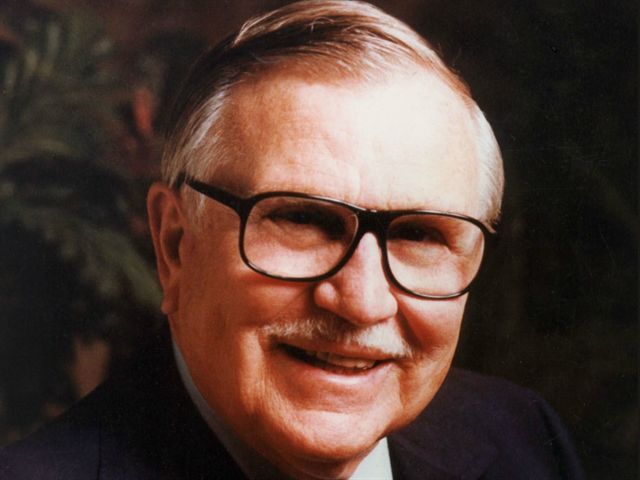
About Dr. J. Vernon McGee
John Vernon McGeewas born in Hillsboro, Texas, in 1904. Dr. McGee remarked, "When I was born and the doctor gave me the customary whack, my mother said that I let out a yell that could be heard on all four borders of Texas!" His Creator well knew that he would need a powerful voice to deliver a powerful message.
After completing his education (including a Th.M. and Th.D. from Dallas Theological Seminary), he and his wife came west, settling in Pasadena, California. Dr. McGee's greatest pastorate was at the historic Church of the Open Door in downtown Los Angeles, where he served from 1949 to 1970.
He began teaching Thru the Bible in 1967. After retiring from the pastorate, he set up radio headquarters in Pasadena, and the radio ministry expanded rapidly. Listeners never seem to tire of Dr. J. Vernon McGee's unique brand of rubber-meets-the-road teaching, or his passion for teaching the whole Word of God.
On the morning of December 1, 1988, Dr. McGee fell asleep in his chair and quietly passed into the presence of his Savior.
Contact Thru the Bible with Dr. J. Vernon McGee
Mailing Address
Thru the Bible, Inc.
P.O. Box 7100
Pasadena, CA 91109
In Canada:
Box 25325,
London, Ontario
N6C 6B1
Phone Number
(626) 795-4145 or
(800) 65-BIBLE (24253)


