Kingdoms Rise and Wane (Part 2 of 2)
Ministries > Truth For Life with Alistair Begg
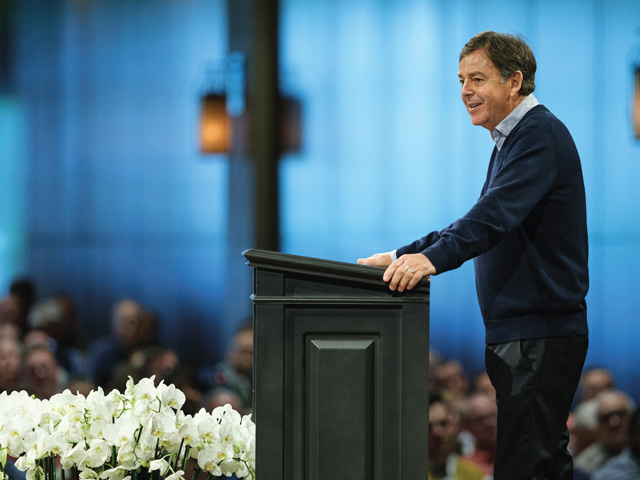
 God gave Daniel a glimpse of the spiritual battles raging behind the scenes of human history—and it destabilized him! Listen to Truth For Life as Alistair Begg walks us through Daniel’s vision and reminds us of our “only comfort in life and death.”
-----------------------------------------
• Click here and look for "FROM THE SERMON" to stream or read the full message.
• This program is part of the series A Study in Daniel, Volume 2’
• Learn more about our current resource, request your copy with a donation of any amount.
• FREE AUDIOBOOK! In our polarized culture, disagreement is often seen as combative and offensive. What if there were a way to do it well? Download your free copy of The Art of Disagreeing by Gavin Ortlund and master how to disagree with kindness and influence. Request yours at ‘truthforlife.org/disagree.’
Helpful Resources
- Learn about God's salvation plan
- Read our most recent articles
- Subscribe to our daily devotional
Follow Us
YouTube | Instagram | Facebook | X
This listener-funded program features the clear, relevant Bible teaching of Alistair Begg. Today’s program and nearly 3,000 messages can be streamed and shared for free at tfl.org thanks to the generous giving from monthly donors called Truthpartners. Learn more about this Gospel-sharing team or become one today. Thanks for listening to Truth For Life!
Guest (Male): God gave the prophet Daniel a peek behind the curtain, so to speak, in the heavenly realm. His glimpse of the spiritual battles that rage behind the scenes of human history destabilized him and perhaps you as well. Today on Truth For Life, Alistair Begg walks us through Daniel's vision, reminding us of our only comfort in life and death. Let's turn in our Bibles to Daniel chapter 11.
Alistair Begg: What do we know? We know that the exiles have been freed to return home. The first year of Darius the Mede was the year when they were set free as a result of a policy of repatriation. They have been allowed to go home, but the news that has filtered back from Jerusalem is that it isn't really going very well. In fact, they are confronted by opposition, and within relatively short order, the rebuilding project is going to come to a crushing halt. Daniel is given an insight by God into what's really going on. In chapter 10, he is taken, as it were, behind the scenes into the unseen realm to get a flavor for the fact that there is a battle that rages in the heavens. What Paul later on writes about, that we don't wrestle against flesh and blood but against spiritual wickedness in the heavenly places. Daniel in chapter 10 is just absolutely destabilized by the immensity of what he discovers, that behind all of the ebb and flow and the topsy-turvy of life for them in their exile and now in their restoration and in looking to the future, there is this battle in the heavens. Made aware then of the fact that these terrible battles are ensuing, it needs to be understood that that which is taking place unseen in the heavens is inevitably being worked out in the seen world of history on the ground, as it were, as it unfolds. For example, in verse two, "And now I will show you the truth, or I'll tell you what's going on. Behold, three more kings shall arise in Persia, a fourth will be richer than all of them. He'll become strong, stir up all against the kingdom of Greece, and then a mighty king shall arise." If you want to do your own cross-referencing, you realize that as you read that, it takes you back to chapter eight and to verse 22, the arrival of a Greek warrior king whose kingdom is split into four parts. He would like to think perhaps that when it goes from him, that it will go into his posterity, but it doesn't. As a result of that, Alexander finds that his experience is a short-lived one despite his might after all. That is a reference to that period. Then when you get into verse five and following with the King of the South and then the kings of the North and so on, I can take you through this part by part. We go through the empires, the Seleucid Empire, the Ptolemaic Empire, the arrival of Antiochus IV Epiphanes, and so on. All of this is actually here in this 11th chapter. If you go and look for it, the thing that will strike you is it is absolutely amazing that six centuries BC there should be such a detailed prophetic outworking of what was going to take place in the drama of world history. Now, let’s pause for a minute and acknowledge that those who are opposed to the Bible, who see the Bible as just a ragbag of material that someone has cobbled together over time, those kind of individuals operate from the basis that it couldn't possibly be that this is prophecy. So when you read those commentaries, they'll tell you that this is actually history dressed up to look like prophecy. All of this is written now in a period of time where all of chapter 11 has already taken place, and then it is written in such a way as to suggest that it is about to take place. I've always found that kind of thing a lot harder to swallow than the real story. The argument is that no man could possibly know what was about to take place. Of course, who’s saying anything about any man knowing about everything that is to take place? You say Daniel knew. Yeah, but how did he know? Because God disclosed it to him. We're going to come to the story of the arrival of the wise men, and Herod got together his wise men and the folks that read the big books of the Magi. He inquired of them where this king was to be born, and he said, "In Bethlehem of Judea, for thus it is written by the prophets." God speaks. God unfolds. God reveals. Now, when you go through this on your own, as I'm sure you're just keen to get out of here and get started on it, then you will find that the drama that unfolds changes in its descriptive dimension from a kind of top-down view of it to a view of it that's a bit like when you're watching soccer on TV. Every so often they'll give you the whole field, and then they will go down to a camera that is right in the middle of the action. Well, the camera here comes right down into the middle of the action. The perspective is that of the glorious land or the beautiful land that you'll find in the text. The beautiful land, the people of God where God has revealed his glory, is squeezed, if you like, between the warfare that comes from the North and from the South. They're in the middle of this great unfolding battle and drama which has ensued throughout history. But you must trust me on this, and then you can prove me wrong later. But if you take, for example, from verse two all the way to verse 20, what you actually have here is essentially a period of time of 355 years from 530 to 175 BC. It is the period of time that covers from Cyrus to Antiochus. Check and you'll find out. When you go beyond that, from 21 to 35, you're dealing with 175 to 163, only 12 years. 355 years are given 19 verses, and 12 years are covered in 15 verses. Remember what we've said, that there's no underlining in the Bible. There's no changing the font size or putting circles around it. So one of the ways you understand emphasis is when the pace slows and the extent of the information is compacted and then conveyed in this kind of way. What is it that there's a preoccupation on here? Well, the answer is in the period of Antiochus Epiphanes IV, who was a major monster, who in endeavoring to destroy the people of God, established his own ideologies. He sought to bring unity to his kingdom by imposing this particular ideology. You can read of it in the text, and the things, the extent to which he went in order to shut things down for the people of God. As a result of that, Antiochus is, if you like, the prototype of many leaders who come after him. I just bought a book in England a couple of weeks ago on Mussolini because I don't know much about Mussolini. I thought I want to find out about Mussolini. I haven't really found out much yet because I haven't had a chance to read much of it. But the little bit that I've read of it, I said, "This sounds a lot like Antiochus." But actually Hitler sounds a lot like Antiochus. Mao Zedong sounds a lot like Antiochus. The regime of North Korea has got a lot of Antiochian developments and perspectives in it. Why would this ever be? Because this character here in Daniel 11 is, I suggest to you, a virtual prototype of everything that is ultimately anti-God. He doesn't embody it in its fullness. One of the challenges of the chapter is: is he still the one in focus as you get to the end, or is he simply giving us an indication of this great monster that will come, the man of lawlessness in 2 Thessalonians and the Antichrist in his embodiment? That’s one of the challenges of interpretation. But when we think about this, what we discover is that the events of the chapter lead us to the end where there is a description that transcends, if you like, the ability of anybody to make sense of it all, pointing us to the one who will then oppose the people of God. But the fact is that even with all of that, it is only going to be for a time. These kings of the North, kings of the South, all of this material here which rages throughout this particular period of time, all have finitude written into them. The affairs of politics are ephemeral. Ultimately the affairs of politics are actually futile. When you think about it, all of the endeavors that have gone into raising up great empires, where are they today? The British Empire? What an amazing amount of effort. How could a tiny little bunch of islands in the middle of the North Sea have such a control over the world? How could they control three quarters of the world's oceans? Where are they now? They're barely a whimper in the European community, barely able to keep themselves alive in the battle for autonomy. No, you see all of these things come to an end. I want you just to notice how this comes again and again. For example, in verse 24, concerning this one who will come into the richest parts of the province and do all these things, and he'll devise plans against strongholds, but notice the end of verse 24: "but only for a time." Verse 27 again: "As for the two kings and their hearts and all these things, and yet it is only for a little while and it is to no avail, for the end is yet to be at the time appointed." Verse 29, you have the same thing: "At the time appointed he will return, but it shall not be this time as it was before." Verse 35, I think it comes again: "And some of the wise shall stumble so that they may be refined, purified, and made white until the time of the end, for it still awaits the appointed time." Let's affirm the fact that we're accepting that this is actually prophecy. Let's affirm the fact that we're dealing here not in the realm of fiction, but in the realm of fact itself. The times and the seasons are appointed by God. When Paul addresses the intelligentsia in Athens, he's unashamed in this. They invite him to come and speak to them. They regard him as a bit of a birdbrain, that's the word they use. He's a babbler. He apparently is able to put on a pretty good talk, and so they invite him to their gathering of the brightest and the best. As he comes to meet them, as it were, in the academy, he says, "First of all, I can see that you're a very religious group of people. I was walking around and I saw that you have various statues and idols and so on. Well, what I want to proclaim to you is the answer to the one statue that I noticed you have a statue there to the unknown God." Well, what I want to do, he says, "I want to tell you about the God that you don't know." How does he begin? He doesn't start off and say, "God is very nice and he'd like to give you some very nice things, and he is quite charming and he's a very amenable character." No, he doesn't start with any of that drivel. He starts: "The God who made the world and everything in it." So we're not talking about a cosmic principle. We're not talking about an idea. We're talking about God: Father, Son, Holy Spirit. Before there was time, before there was anything, there was God. As he goes on in that speech in Athens there, which we have simply as a summary, I'm sure, because it's over in about three minutes if you read it, therefore I can only assume it went on for longer. What does he say? He says that this God who made the world established the habitations of men and women. He established where nations were set. He established both the geographic boundaries and he established the periods of history. You see how alien this is to the idea that somehow or another God is whatever we want God to be. No. So what we have to do is allow Daniel to help us to this end, namely to view history, the unfolding drama of history, from the perspective of Scripture. To learn to read our newspapers through the lens of Scripture rather than the other way around. To bring to bear upon the daunting challenges of our day and the reading of history what the Bible tells us is true. Isaiah chapter 40 and verse 12: "Who has measured the waters in the hollow of his hands? Behold, the nations are like a drop from a bucket and are accounted as the dust on the scales. He takes up the coastlands like fine dust." Who can do this? Only God. You see, we don't believe in God. We don't believe in God. You see, if you believe in God, then everything else falls into line. But we don't believe in God. We believe in God insofar as he meets our expectations, or as he fulfills our designs, or as he accomplishes our purposes. But a God who takes away our children in their infancy, a God who takes us through deep, dark valleys, a God who allows his people to be carried away into degradation for 70 years and when they're returned is faced by the most animosity that they could ever imagine, a God who allows his own Son to be crucified on a cross and who raises him on the third day? We don't believe in that God. No, we have a God who is a cosmic principle, who's an idea, who's around if you need him. No, this is the God who sets up kings and authorities. Proud empires, all the people that gathered in Paris this past week, there they are in all of their finery, all of the dignities, all of the cars, all of the limousines, all of the everything as they all sat there while the world is going crazy underneath them. The pomposity of it all. Boy, I would have loved to have given a speech there. I would like just a little time, just an opportunity, and this is what I would read to them. I said, "Listen, he sits above the circle of the earth, and its inhabitants are like grasshoppers. He stretches out the heavens like a curtain and he spreads them like a tent to dwell in. He brings princes to nothing, and he makes the rulers of the earth as emptiness." Well, that's not very nice. You'll never get invited back if you do that once. I know that, but just once would be enough. I'd like the chance to make it clear that God is not a passive bystander in the world that he has made. He controls the details of human history. He accomplishes his eternal purposes and he definitely will. It is to the people of God that he gives this vision, both in terms of the unseen world of the heavens, which modern man says is a joke and yet goes to see the spook lady in the center of Chagrin Falls, and yet goes on the internet and tries to find out about his future, and says bizarre things when he goes to the funeral of his friend. But he doesn't believe that there is actually kingdoms in conflict, that there is a world beyond? Yes, he does. Yes, he does. But it is a disaster to assume that this God who's engaged in that realm would come and step down in this way. Think about it. We used to sing it in Scotland as a boy. The longer I live, the more I thank God for the providence of God in my life. It's why I'm so exercised about what we're doing with our children, and not only in buildings, but in every dimension. You cannot quantify the benefit of instilling in their young hearts and minds these truths. How can I pull stuff back the way I do? Because of what I enjoyed when I was three. Kingdoms may rise and kingdoms may fall. Nations refuse to heed God's call, but the word of the Lord endures forevermore. Put your trust in Jesus. I'm quoting now. Put your trust in Jesus, he will be your friend. He will guide and keep you till your journey's end. Kingdoms may rise, kingdoms may fall. Nations refuse to heed God's call, but the word of the Lord endures forevermore. Now, you got to understand, this is 1957, 1958. We on the school bus are still singing, "Rule Britannia, Britannia rule the waves. Britons never, never, never shall be slaves." Our little voices on the bus singing it like crazy. We rule the world, we're the champions of the world. We'll come one, come all. Then we go to Sunday School: kingdoms will rise, kingdoms will fall, put your trust in Jesus. I get it. Do you get it? Let me end where I began. What is your only comfort in life and in death? What do you have as the answer to the big question? The big question: one, where did I come from? Two, what am I? Three, where am I going? If your view of the world does not give you a sufficient answer to those questions, you need a new view of the world. And I've got it right here for you in Daniel 11. God is on the throne and comes from his throne to a manger, and from a manger to a cross and to a borrowed tomb, and to the throne. And from the throne to those who in answer to the question, "What is my only comfort in life and in death?" are able to say, "My only comfort is that I am not my own, but belong body and soul, in life and death, to my Savior Jesus Christ." I wonder, can you say that today? I wonder will you consider what it might mean for you to bow down and acknowledge God as God.
Guest (Male): Alistair Begg reminding us of the importance of viewing everything from the Bible's perspective. You're listening to Truth For Life. Alistair will return in just a moment. We often share feedback from our listeners. Recently, Mark wrote to us to say, "I'm so glad I've discovered Truth For Life and the way you deliver God's word with such passion and eloquence. I've been listening to the sermons for months now, and they have truly opened my eyes and my heart." We're thankful that people like Mark, people from all over the world, are still discovering Alistair's Bible teaching on Truth For Life. Millions of people visit our website every year. This program is on nearly 2,000 radio stations, as well as YouTube and various apps and streaming platforms. Alistair's books are now available in more than 30 languages. God's been working through Truth For Life's ministry for three decades, and we pray that he'll continue to do so for many more. All of this is made possible by a faithful group of listeners just like you who donate each month to the ministry of Truth For Life. We call them Truth Partners. Now, you may not realize that Truth For Life is entirely listener-funded. It is your generous giving that covers the cost of producing and distributing this daily program, that enables us to offer free and at-cost resources, to maintain an online library full of thousands of Alistair's sermons, and to participate in many gospel outreach projects. If you've been listening to and benefiting from Alistair's teaching for a while, why don't you join the Truth Partner team today? You can decide how much you'd like to give each month. To sign up, visit truthforlife.org/truthpartner or call us at 888-588-7884. Now, here's Alistair to close with prayer.
Alistair Begg: Father, thank you that in the midst of all of this, we might have our hearts and minds attuned afresh to you, the living God. We think big thoughts of ourselves and small thoughts of you, and we wonder why our lives are upside down. We fill our lives with every kind of substitute even though you made us for yourself and our hearts are restless till they rest in you. We go down just about every other pathway. Some of us are here this morning and we don't have a decent answer to the question. We may be unbelieving in relationship to Daniel 11, it just seems totally nuts, far-fetched, craziness. Lord, open our eyes and grant that we might find in Jesus all that we long for. For we pray humbly in his name, amen.
Guest (Male): We are glad you've joined us today. You know, throughout history, we've seen many evil leaders rise and fall. So who is the ultimate abomination of desolation that Daniel describes, and how will we recognize him? We'll find out tomorrow. The Bible teaching of Alistair Begg is furnished by Truth For Life, where the learning is for living.
Related Episodes
The Time of the End
Wednesday, August 12
Kingdoms Rise and Wane (Part 1 of 2)
Monday, August 10
“Do You Believe…?” (Part 3 of 3)
Saturday, August 8
About Truth For Life
Truth For Life distributes the unique, expositional Bible teaching of Alistair Begg. Studying God’s Word each day, verse by verse, is the hallmark of this ministry. In a desire to share the good news of the Gospel without cost as a barrier, the entire teaching archive is available for free download and resources are available at cost with no markup.
About Alistair Begg
Alistair Begg has been in pastoral ministry since 1975. Following graduation from The London School of Theology, he served eight years in Scotland at both Charlotte Chapel in Edinburgh and Hamilton Baptist Church. In 1983, he became the senior pastor at Parkside Church near Cleveland, Ohio. He has written several books and is heard daily and weekly on the radio program, Truth For Life. The teaching on Truth For Life stems from the week by week Bible teaching at Parkside Church. He and his wife, Susan, were married in 1975 and they have three grown children.Contact Truth For Life with Alistair Begg
Website
http://www.truthforlife.org/?utm_source=oneplace&utm_medium=sitelinks&utm_campaign=home
Mailing Address
Truth For Life
P.O. Box 398000
Cleveland OH 44139
Telephone (Customer Service)
888-588-7884 Domestic
400-543-6800 International
440-543-0522 ( Fax)


