The Coming of the Lord (Part 1 of 6)
Ministries > Truth For Life with Alistair Begg
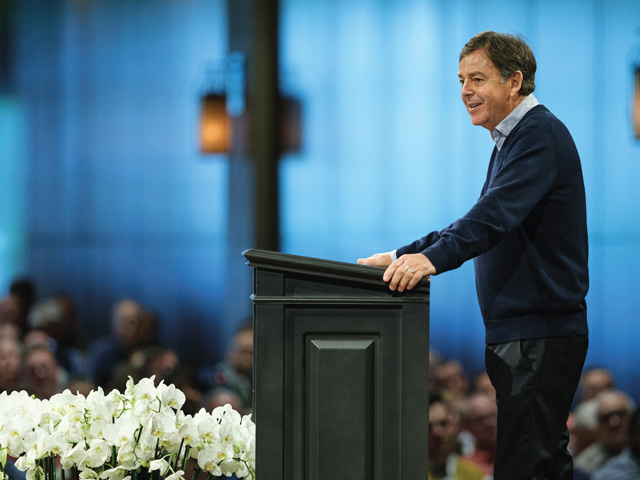
 When Jesus returns, how will we know it’s really Him, not an impostor? As Alistair Begg often says, “The main things are the plain things, and the plain things are the main things.” On Truth For Life, we’ll examine the clear answers given in Scripture.
-----------------------------------------
• Click here and look for "FROM THE SERMON" to stream or read the full message.
• This program is part of the series A Study in 1 Thessalonians, Volume 2’
• Learn more about our current resource, request your copy with a donation of any amount.
• FREE AUDIOBOOK! In our polarized culture, disagreement is often seen as combative and offensive. What if there were a way to do it well? Download your free copy of The Art of Disagreeing by Gavin Ortlund and master how to disagree with kindness and influence. Request yours at ‘truthforlife.org/disagree.’
Helpful Resources
- Learn about God's salvation plan
- Read our most recent articles
- Subscribe to our daily devotional
Follow Us
YouTube | Instagram | Facebook | X
This listener-funded program features the clear, relevant Bible teaching of Alistair Begg. Today’s program and nearly 3,000 messages can be streamed and shared for free at tfl.org thanks to the generous giving from monthly donors called Truthpartners. Learn more about this Gospel-sharing team or become one today. Thanks for listening to Truth For Life!
Guest (Male): How will we know when Jesus returns, and how can we be certain it's really him and not an impostor? As Alistair Begg often says, "The main things are the plain things, and the plain things are the main things." So today on Truth For Life, he'll walk us through the clear answers given in scripture.
Alistair Begg: Last time in beginning this section, we noted the foundation upon which Paul was building the conviction and expectation of the return of the Lord Jesus Christ. And that, there in verse 14, "We believe that Jesus died and rose again." This, we took time to emphasize, is the very cornerstone of Christian truth and belief. And it is upon this very platform that all of the rest is grounded and the superstructure is built. That for the believer to profess the expectation of the return of Jesus Christ is not simply to engage in idle speculation nor to build some kind of flimsy superstructure of philosophical meanderings, but it is to be grounded on these great historical verities. And we made much of the fact that Christianity is historical in its basis, that it is not ultimately enough to say, "You ask me how I know he lives? He lives within my heart," because there would be many people who might make all kinds of subjective claims concerning truth. But it is important ultimately to be able to say to the agnostic mind, "You must examine the evidence. You must consider the claims. For here is the foundation." The conviction, which we said emerged from the foundation, is also there in verse 14. "Since we believe that Jesus died and rose again, so then we believe that God will bring with Jesus those who have fallen asleep in him." In other words, the platform of biblical doctrine is the springboard for biblical hope. Why, says somebody, do you believe that Jesus is going to come back? Well, we answer, because he died and he was raised from the dead. And since he was raised from the dead as the first fruits of those who have fallen asleep, he will in turn bring with him those who have fallen asleep in him. And again, last time, we made much of the fact that one of the things that distinguishes the believer from the unbeliever in our day is that the unbeliever has ultimately nothing to look forward to and no God to whom they might turn, whereas the believer has everything to look forward to insofar as they have the God and Father of our Lord Jesus Christ to whom they might turn. Now, we left it at that point saying that we would come back to the nature of the expectation which is the Christian's. And to this we come, having built it further in verse 15. "According to the Lord's own word, we tell you that we who are still alive, who are left till the coming of the Lord, will certainly not precede those who have fallen asleep. For the Lord himself will come down." Now, I want this morning to try and summarize the expectation of believing faith by using five words: the Return, then the Resurrection, then the Rapture, then the Reunion, and then the Responsibility. The first four of these words I glean from John Stott, who summarized this so helpfully that when I read his summary, I couldn't improve upon it and so I was forced to use it or to provide you with a less than helpful summary. So you ought to be grateful, one, that I'm using it and, two, that I'm honest enough to admit it. And he cannot be held responsible for the meat that goes around the bones, however. First of all, then, the issue of the return of Jesus Christ. Verse 16 summarized in the paraphrase of J.B. Phillips in this way: "One word of command, one shout from the archangel, one blast from the trumpet, and the Lord himself will come down from heaven." The word which is used here is the word *Parousia*. Some of you may have come across this word, the *Parousia*. It is referring to the coming or the presence of the Lord Jesus. And where you read the word "the *Parousia*," you are reading about the coming, the return expressly of Jesus. It was not an unfamiliar word for Paul's early readers because it was the word that would be used to designate the expectation of the arrival of some big dignitary. And if someone was coming into town, an emperor or a distinguished person, the word was going around that there was to be a *Parousia*. And the identifiable feature of it was to be the grandeur and the definite and decisive nature of it. And so Paul picks up this word and he says, "I want you to understand that there is nothing vague, there is nothing ultimately cloudy concerning this event towards which the church looks. The return of Jesus Christ is to be decisive and it is to be definite." When we think of the return of Jesus, we're not thinking of an issue that somehow or another you have to go ferreting around and looking for, picking up stones and boulders, as it were, of biblical truth in the hope that we may discover it somewhere. No, the very fact of the return of Jesus is replete throughout the whole of the New Testament. And if you doubt this, you need only to scan the gospel records. For example, in Matthew's Gospel, you find him giving great emphasis to it in the 24th chapter. And you will do well to study chapter 24 and also into 25. And the words of Matthew, for example, in verse 26, "So if anyone tells you, 'There he is, out in the desert,' do not go out; or, 'Here he is, in the inner rooms,' do not believe it." Because he says it's going to be a cosmic event, it's going to be a universal event, it's not going to be a localized event. I remember in the 70s in London, there was a chap who was wandering around who had long blond hair, wore a white robe, and sometimes had a large walking stick. And he used to be in Regent Street, he was down on Piccadilly Circus, he was everywhere, and he was announcing the fact that he was Jesus and he was back. And there were some people who were taking time to wonder about this. Is he really back? And the answer was, he's flat-out not back. And people said, "Well, how do you know? I mean, after all, he seems to be a nice kind of person and he's not doing anything bad and he seems to have some of the jargon to proclaim." Well, the answer is Matthew chapter 24 and verse 25. If somebody says he's at Piccadilly Circus, don't go down to Piccadilly Circus, he's not there. If somebody says he's up at Marble Arch, don't go to Marble Arch, he's not there. Why? Because when he comes, it will not be localized, it will be dramatic and it will be universal. Interestingly enough, in passing and this weekend of rock and roll, in one of the biographies of Paul McCartney, it mentions the fact that this character, whom I met on a number of occasions, showed up at Paul McCartney's front door in St. John's Wood, rang the front doorbell. McCartney answered the door, said, "Hello." The chap said, "I am Jesus." So McCartney said, "You are? Come in." Brought him in, made him a cup of tea and talked with him. And then he was going to Abbey Road Studios to record "Let It Be." And so he said to the chap, "Would you like to come to the recording?" So he takes this blond-haired guy with a white robe and his walking stick to the Abbey Road Studios and introduced him to John Lennon and Harrison and Ringo Starr and said, "Guys, this is Jesus, and he was over at my house for a cup of tea." And the biographer says, "And so this was the closest the Beatles ever came to meeting Jesus." But he wasn't remotely related to Jesus. And there will be many of these Jesuses walk upon the stage of human history. Don't be deceived by them. They are the spirit of the Antichrist which is gone out into the world. When somebody says he's in the desert, "Let's go there," he's over here, "Let's go there," don't even move. You don't need to. And that's what Matthew 24 is largely about. When you go into Mark's Gospel, read Mark 13. You go into Luke's Gospel, read 21. You go to John's Gospel, read John 14. John 14, the opening verses, were not written for funeral services. They read it at funeral services and that's okay. But they were not written to comfort the dead and the dying and the bereaved. They were written to encourage these believers to understand that when Jesus went away, he was coming back. He looked into their eyes and he saw that there was a dimming of their expectations, that they had begun to fasten on the fact that this was not going to end up the way they had anticipated. And Jesus says, "Hey, don't let your hearts be troubled. You believe in God, believe also in me. In my Father's house are many rooms. If it were not so, I would have told you. I'm going to prepare a place for you. And if I go and prepare a place for you, I will come again and receive you unto myself, that where I am, there you may be also. And you know the way to the place where I'm going." And good old Thomas gives voice to what no one else is prepared to give voice to. The kind of kid who in the class asks the question that you're hoping somebody will ask because you haven't got a clue what's going on. So Thomas launches out. He says, "Lord, we don't know where you're going and how can we know the way?" And Jesus said, "I am the way, the truth, and the life. And no one comes to the Father but by me." You find the same thing in the Acts of the Apostles when, following the ascension of the Lord Jesus, the angel comes and the people are standing looking up. Jesus, having been taken up before their very eyes and a cloud has now hid him from their sight, Acts chapter 1, verse 9. And they were looking intently up into the sky as he was going. You bet your life they were. When suddenly two men dressed in white stood beside them. "Men of Galilee," they said, "why do you stand here looking into the sky?" Now, that must have caught them on the hop for just a moment. My answer would have been, "What do you mean why do we stand here looking into the sky? Did you see this? Did you miss this? Jesus was here and he took off. And last we saw of him, he was caught up into that cloud." But their question, you see, was directly related to the fact to remind the church that its responsibility is not to be focused in the matters of curiosity, but the responsibility of the church is to be focused on the matters of certainty, namely, this same Jesus who has been taken from you into heaven will come back in the same way you have seen him go into heaven. That's the main thing. That's the plain thing. That is the expression concerning the return of Jesus Christ. His coming is going to be climactic for existence as we know it. The coming of Jesus will transcend all events in time and space. We cannot even begin to conceive of what it will be like. All of our best approximations concerning computer link-ups and worldwide television exposure and all these things, I don't think we've got an inkling of what it will be like. I think he's going to introduce a whole new deal. There's nothing been seen like it. There will be nothing seen after it. We have not seen, eye has not seen, neither has ear heard, neither has it entered into the heart of man, the things that God has prepared for them that love him. What's it going to be? The Lord himself will come down from heaven with a loud command, the voice of the archangel, and with the trumpet call of God. There's going to be a loud shout, used of the charioteer to his horses. I never was on a chariot. The closest I came was watching the movie *Ben-Hur*. And I recall then that the charioteer spoke to the horses. And not like, "Coo-coo, come on, come on, horsey. Whoa, come on now." No, nothing like that. Dramatic, decisive. "Move it. Let's go." If people think that Jesus is going to come back with some little whimper somewhere in a corner, they are flat-out wrong. When he sounds out that voice, the dead will hear it, he says. It will be a magnificent, cosmic event. The world does not believe because the world has been blinded. Their minds have been blinded by the god of this age, the prince of the power of the age, Ephesians 2:2. But the fact that man in his blindness cannot see it no more denies the reality of it than a man in his blindness being unable to see the light of the sun denies the reality of the sunlight. The voice will be that of a charioteer to his horses, a hunter to his hounds, the cry of a captain to the rowers in the galley slave of a great ocean-going vessel of Paul's day, the voice of a commander to his soldiers. It is to be a voice of authority. It is to be a voice of urgency. And it will be accompanied by this great trumpet blast and call of God. Now, when we begin to just peel back the pages of Scripture in relationship to the return of Jesus Christ, we can go in so many different directions. But let me remind you of what I always try to remind you of, namely, that the main things are the plain things and the plain things are the main things. And when we take the main plain expressions of the return of Jesus, we can say categorically that the return of Jesus will be dramatic. Matthew 24, once again, and verse 30. Let me just quote it for you. Someone may ask you and you'll be able to tell them, "At that time, the sign of the Son of Man will appear in the sky, and all the nations of the earth will mourn. They will see the Son of Man coming on the clouds of the sky with great power and with great glory. And he will send his angels with a loud trumpet call—there you have the trumpet—and they will gather his elect from the four winds from one end of the heavens to the other." Now, human language is beggared before an ability to try and encapsulate in a sentence or two the magnificence and the grandeur of this dramatic event. You have the same approximation to it in Revelation, and in chapter 1 and in verse 7. "Look, he is coming with the clouds, and every eye will see him, even those who pierced him; and all the peoples of the earth will mourn because of him. So shall it be! Amen." The apostle John, anticipating this, giving encouragement to the beleaguered believers of the first century who are having their heads torn off, who are being thrown to the lions, who are being buffeted by all kinds of hatred vented against them. The Book of Revelation is not there for idle curiosity for people to get PhDs fiddling with the minutiae of it. The Book of Revelation is there to express the fact that we are more than conquerors, that we are looking forward to this great dramatic return of the Lord Jesus Christ. It is also true to say that this return will be decisive. 1 Corinthians 15, we saw this, verse 24. Paul, writing concerning Jesus' return, he says, "Then the end will come, when he hands over the kingdom to God the Father after he has destroyed all dominion, authority, and power. For he must reign until he has put all of his enemies under his feet. And the last enemy to be destroyed is death." So when he speaks and the dead are raised, you know and everyone comes to see that Jesus has declared his authority over all of this. So the return of Jesus will be dramatic, it will be decisive, and it will be sudden. 1 Thessalonians 5, we'll come to this. "Now, brothers, about times and dates, we do not need to write to you, for you know very well that the day of the Lord will come like a thief in the night. While people are saying 'peace and safety,' destruction will come on them suddenly as labor pains on a pregnant woman, and they will not escape." Now, I say to you again, when we just take the lid off the New Testament teaching on the return of Jesus, we can go in so many different directions. But for now, I want you to notice that here in this verse 16, we have what is the fullest New Testament description of the *Parousia*, namely, the return, the coming of Jesus Christ. This is the most succinct and fullest statement: "For the Lord himself will come down from heaven with a loud command, with the voice of the archangel, and with the trumpet call of God, and the dead in Christ will rise first." You say to yourself, if this is the fullest statement and there's so very little here, surely we ought to be very careful about undue dogmatism in seeking to tell the whole story down to the minutest detail. Answer, yes, we certainly should. And yet what has the history of the church been in the last 200 years? It has been a forsaking of the big picture, a preoccupation with the tiniest details, and then some of the most horrendous debates, discussions, arguments, and declensions over things about which the Bible is not dogmatic and, therefore, a great loss of that over which the Bible is absolutely certain. Do you remember the little mouse that went to London to see the queen? "Little mouse, little mouse, where have you been? I went to London to visit the queen. Little mouse, little mouse, what did you there? I chased another mouse under the chair." So the mouse goes to see the queen, loses sight of the queen on account of other mice, starts chasing around all underneath the furniture. Classic picture of the church at the end of the 20th century in relationship to the return of the King. Chasing round underneath the furniture, arguing about bits and pieces and corners and nooks and crannies and missing the main issue. Do you believe he's coming? Yes, he's coming. Therefore, it has implications. Now, from the return, we go to the resurrection. "The Lord himself will come down from heaven with a loud command," and so on. End of verse 16, "And the dead in Christ will rise first." Thursday at Lakeview Cemetery, I was pondering this as I anticipated preaching it. As I drove all around there, but as I wandered around all those tombstones, I said to myself, "You know, 1 Thessalonians 4 says that the dead in Christ will rise first." I mean, there's going to be some funeral procession going down round there when all of a sudden it all cuts loose and people start coming out of those places, just unbelievably dramatically. You say, "Oh, we can't believe this. This is far-fetched." Let me tell you something: we can believe this. We do believe this. We must believe this. We need to preach this. And Jesus himself taught it in John chapter 5, in teaching concerning life in his name. He says, "I tell you the truth"—verse 25 of John 5—"a time is coming and has now come when the dead will hear the voice of the Son of God, and those who hear will live." People must have been saying, "I wonder what he means by that?" And in verse 28, he says, "Do not be amazed at this, for a time is coming when all who are in their graves will hear his voice and come out. Those who have done good will rise to live, and those who have done evil will rise to be condemned." He speaks and listening to his voice, new life the dead receive.
Guest (Male): The return of Christ will be a dramatic, universal event that will be impossible to miss. We’ll hear more about it tomorrow on Truth For Life with Alistair Begg. Since Jesus' return will be decisive and without warning, sharing the gospel isn’t just a nice thing we do; it’s an urgent life-or-death matter. Have you ever planned to talk with someone about Jesus, and then when they resisted, you backed off to avoid conflict? If that sounds familiar, take advantage of the offer we're making today to download a free audiobook titled *The Art of Disagreeing*. This is a book written to help believers share the gospel and effectively navigate differences of opinion with kindness and courage and truth so that relationships can be strengthened rather than damaged. The author is Pastor Gavin Ortlund, and he explains why everyone needs to hear the gospel and understand the eternal consequences that come with rejecting Jesus. In the audiobook, he'll teach you skills to engage in persuasive conversations. For example, you'll learn how to avoid negativity by listening effectively and sympathizing with others' perspectives. You'll learn how to use sound reasoning and tactful words so you can gain understanding and build trust. Don't miss out. Today is the last day you can download *The Art of Disagreeing* audiobook for free from Truth For Life. Visit truthforlife.org/disagree. Today is also the last day we're recommending the book *The Language of Rivers and Stars: How Nature Speaks of the Glories of God*. If you've not yet requested your copy, give us a call at 888-588-7884. It's yours for a donation. You can also request the book when you give a gift online at truthforlife.org/donate. Thanks for joining us today. Talk of Christ's return and the rapture often sparks curious questions and speculation. Tomorrow, we'll learn where our focus ought to be and what should always be our priority. The Bible teaching of Alistair Begg is furnished by Truth For Life, where the learning is for living.
Related Episodes
The Coming of the Lord (Part 2 of 6)
Tuesday, September 1
“Are We Blind Too?” (Part 2 of 2)
Saturday, August 29
Those Who Have Hope (Part 2 of 2)
Friday, August 28
About Truth For Life
Truth For Life distributes the unique, expositional Bible teaching of Alistair Begg. Studying God’s Word each day, verse by verse, is the hallmark of this ministry. In a desire to share the good news of the Gospel without cost as a barrier, the entire teaching archive is available for free download and resources are available at cost with no markup.
About Alistair Begg
Alistair Begg has been in pastoral ministry since 1975. Following graduation from The London School of Theology, he served eight years in Scotland at both Charlotte Chapel in Edinburgh and Hamilton Baptist Church. In 1983, he became the senior pastor at Parkside Church near Cleveland, Ohio. He has written several books and is heard daily and weekly on the radio program, Truth For Life. The teaching on Truth For Life stems from the week by week Bible teaching at Parkside Church. He and his wife, Susan, were married in 1975 and they have three grown children.Contact Truth For Life with Alistair Begg
Website
http://www.truthforlife.org/?utm_source=oneplace&utm_medium=sitelinks&utm_campaign=home
Mailing Address
Truth For Life
P.O. Box 398000
Cleveland OH 44139
Telephone (Customer Service)
888-588-7884 Domestic
400-543-6800 International
440-543-0522 ( Fax)


